
Kansas general state sales tax rate before local taxes.
Remote sellers should monitor Kansas sales against the economic nexus threshold.
Returns are commonly due by the 25th after the reporting period, based on assigned frequency.
Quick answer for ecommerce sellers.
If you sell taxable products or taxable services into Kansas, you may need a Kansas sales tax permit and recurring returns if you have Kansas physical presence or meet Kansas economic nexus rules. Kansas remote sellers generally monitor whether sales into Kansas exceed $100,000 in the current or immediately preceding calendar year.
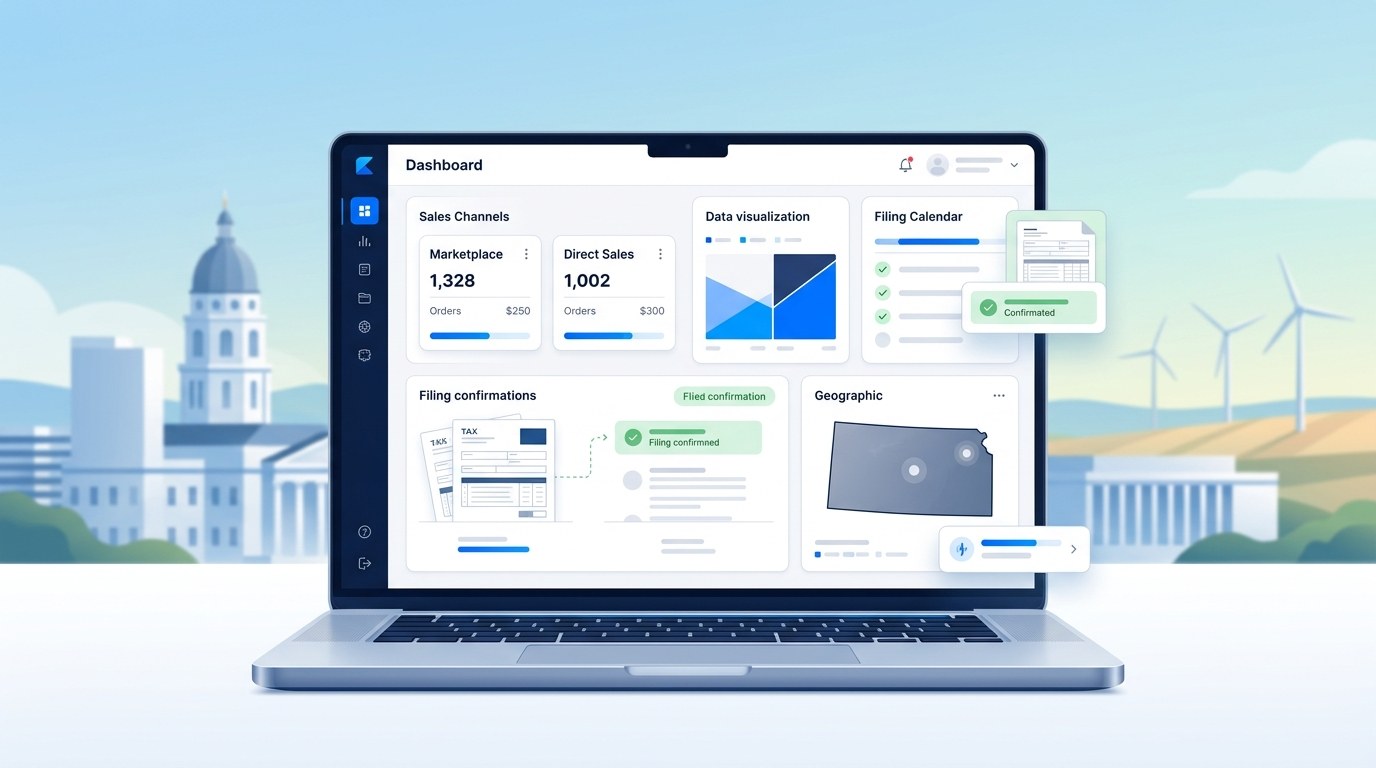
Kansas is destination-based, so local rate handling matters. A filing-ready packet should show direct sales, marketplace-facilitated sales, local jurisdictions, exempt sales, refunds, tax collected, and the final filing confirmation.
What creates Kansas sales tax nexus?
Kansas nexus can come from physical activity, inventory, employees, representatives, affiliated activity, or remote seller volume. Ecommerce merchants should review all sales channels and fulfillment locations before deciding whether a permit is required.
- Physical presence: inventory, employees, facilities, contractors, or representatives in Kansas can create obligations.
- Economic nexus: monitor Kansas sales against the $100,000 threshold.
- Marketplace activity: marketplace sales should be separated from direct sales for threshold and filing review.
- Local sourcing: delivery location can affect the combined state and local tax rate.
How Kansas registration fits into the workflow.
Kansas sellers commonly register and manage sales tax accounts through Kansas Department of Revenue online systems. Before registration, gather the entity name, EIN, responsible party, business address, sales start date, product categories, marketplace channels, and payment owner.
After the account is active, save the permit information, online account owner, assigned filing frequency, local-rate process, payment method, and reviewer assignment in the compliance workspace.
Collection, food tax, local rates, and marketplaces.
Kansas has a 6.5% general state sales tax rate, and local taxes can increase the combined rate. Kansas also phased the state sales tax rate on food and food ingredients down to 0% beginning in 2025, though local taxes can still matter. Merchants should confirm product taxability and local sourcing instead of assuming one statewide treatment.
- Direct ecommerce sales: orders where the merchant is seller of record and may need to collect Kansas tax.
- Marketplace sales: Amazon, Walmart, Etsy, eBay, and other marketplace orders should be isolated before return preparation.
- Local rates: city, county, and special jurisdiction taxes should tie to delivery-location data.
- Exempt sales: resale certificates and exemption support should be retained with the return packet.
- Refunds and adjustments: credits, returns, and tax adjustments should be reconciled to the filing period.
How to prepare a Kansas sales tax filing packet.
Kansas sellers commonly file and pay through the Kansas Department of Revenue Customer Service Center. Filing frequency can be monthly, quarterly, or annual depending on the account. Returns and payments are commonly due by the 25th day after the reporting period, with annual returns generally due January 25.
- Export exact-period reports: pull orders, refunds, tax, marketplace, exemption, and payout files.
- Separate channels: split direct website orders from marketplace-facilitated sales.
- Map Kansas totals: document gross sales, taxable sales, exempt sales, local rates, deductions, and tax collected.
- Reconcile records: compare platform tax, payment processor data, accounting, and marketplace reports.
- Prepare reviewer notes: record source files, assumptions, exceptions, preparer, reviewer, and approval time.
- Save proof: keep the filing confirmation, payment receipt, source exports, and workpapers together.
What happens if Kansas filings are late or unsupported?
Late filing, late payment, incorrect local-rate treatment, unsupported exemptions, marketplace duplication, and weak records can create penalties, interest, notices, amended returns, or audit work. The packet should let a reviewer recreate every return number from source files.
Before filing, review this checklist:
- Does the filing period match every export?
- Are direct and marketplace sales separated?
- Does each taxable order have enough location detail for local rate review?
- Are resale and exemption records saved?
- Do refunds and tax collected reconcile to accounting?
- Was the filing confirmation and payment proof saved?
Kansas sales tax FAQ.
What is Kansas economic nexus?
Kansas remote sellers generally monitor whether sales into Kansas exceed $100,000 in the current or immediately preceding calendar year.
What is the Kansas sales tax rate?
Kansas has a 6.5% general state sales tax rate. Local city, county, and special jurisdiction taxes can also apply.
Where do Kansas sellers file?
Kansas sellers commonly file and pay through the Kansas Department of Revenue Customer Service Center.
Do marketplace sales need to be separated?
Yes. Marketplace-facilitated sales should be separated from direct ecommerce sales because collection and reporting responsibility may differ.
Can AtomicTax help file Kansas returns?
Yes. AtomicTax helps ecommerce merchants prepare filing-ready packets and complete standard sales tax filings for $45 per filing.
Official Kansas resources to check.
Need help making Kansas filings repeatable?
AtomicTax prepares sales tax filing packets from ecommerce reports, separates marketplace and direct-channel activity, and helps merchants keep every filing period reviewable.