Iowa's state sales tax rate before local option taxes.
Remote sellers should monitor Iowa sales against the economic nexus threshold.
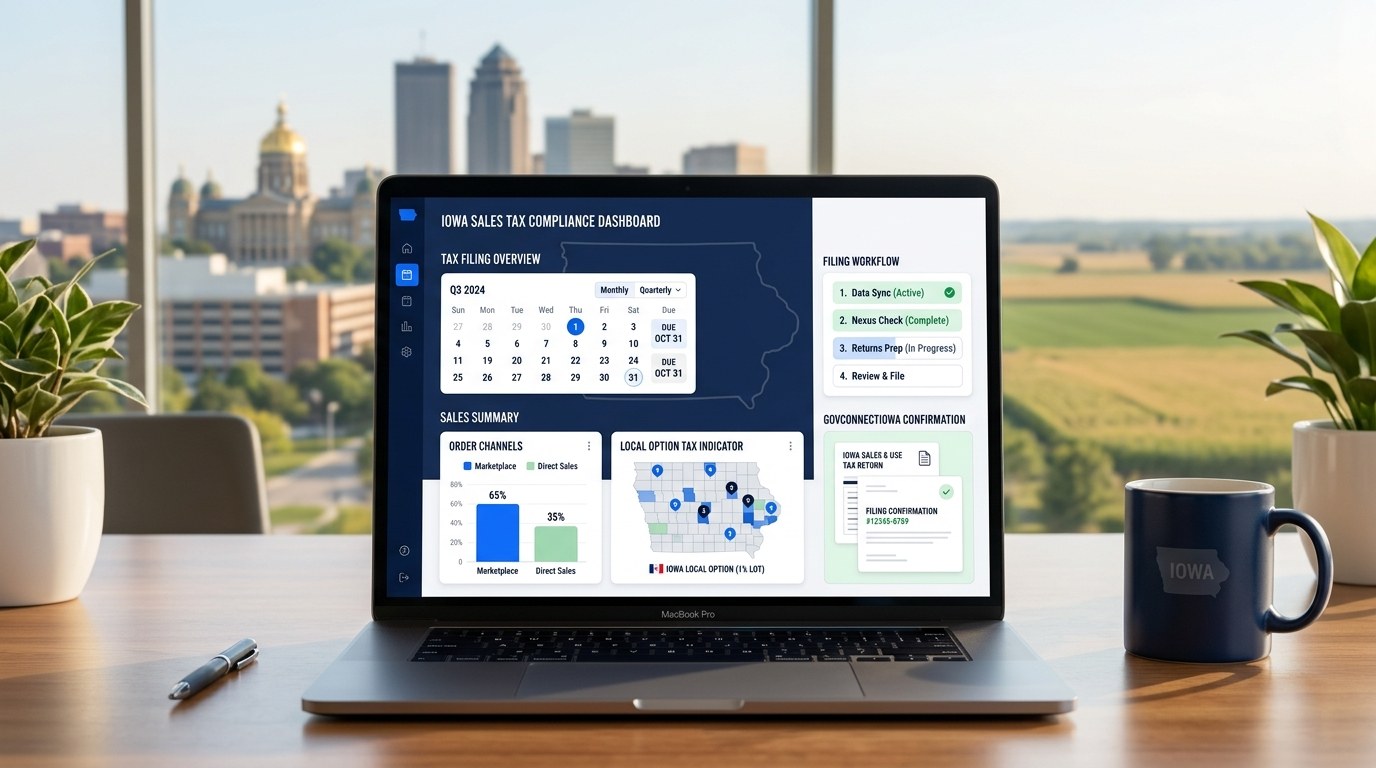
Iowa registration, filing, payments, and account management flow through GovConnectIowa.
Quick answer for ecommerce sellers.
If you sell taxable products or taxable services into Iowa, you may need to register, collect, file, and remit Iowa sales tax if you have Iowa physical presence or meet Iowa's economic nexus rules. Iowa remote sellers generally monitor whether Iowa sales exceed $100,000 in the current or immediately preceding calendar year.
Iowa's filing work should be built around source reports. That means separating direct ecommerce sales from marketplace-facilitated sales, confirming local option tax treatment, retaining exemption support, reconciling tax collected, and saving the GovConnectIowa confirmation with the workpapers.
What creates Iowa sales tax nexus?
Iowa nexus can come from physical presence, remote selling volume, or other business activity connected to Iowa. A remote seller should review all sales into Iowa, including sales made through marketplaces, when evaluating whether the economic nexus threshold is met.
- Physical presence: inventory, employees, contractors, offices, warehouses, representatives, or other Iowa business activity can create obligations.
- Economic nexus: monitor Iowa sales against the $100,000 threshold in the current or immediately preceding calendar year.
- Marketplace sales: Iowa guidance says marketplace sellers may only need to collect on direct sales, but marketplace sales can still matter for threshold review.
- Taxable services and products: tangible goods are commonly taxable, and Iowa also taxes specified services and digital products.
The operational answer is to keep a nexus log that ties Iowa gross sales, direct sales, marketplace sales, exempt sales, local option tax, and registration decisions to the same source files used for returns.
How Iowa registration fits into the workflow.
Iowa businesses use GovConnectIowa to register, manage permits, file returns, and make payments. Before registering, gather the legal entity name, EIN, responsible parties, business address, sales start date, product categories, marketplace channels, expected filing owner, and payment method.
After registration, save the Iowa permit information, GovConnectIowa account owner, filing frequency, local-rate process, payment settings, and reviewer assignment. This prevents a common handoff problem: the account exists, but nobody knows who owns the next return.
Collection, local option taxes, and marketplaces.
Iowa's state sales tax rate is 6%. Many jurisdictions can add local option sales tax, so the delivered location and platform tax settings matter. Iowa also has marketplace facilitator rules requiring marketplaces to collect applicable Iowa sales tax and local option sales tax for many marketplace transactions.
- Direct ecommerce sales: orders where the merchant is seller of record and may need to collect Iowa tax.
- Marketplace sales: Amazon, Walmart, Etsy, eBay, and other marketplace orders should be separated before return preparation.
- Local option tax: confirm whether destination jurisdictions add local option sales tax and whether the platform calculated it correctly.
- Exempt sales: retain resale and exemption certificates, product taxability support, and buyer documentation.
- Refunds and adjustments: preserve credits, refunds, discounts, and tax adjustments in the same period packet.
How to prepare an Iowa sales tax filing packet.
Iowa sellers use GovConnectIowa to file returns and pay sales tax. Iowa filing schedules can vary by account and liability level, so use the assigned frequency shown in the account. Many operational calendars separate monthly payment deadlines from periodic return filing, so the reviewer should confirm the current GovConnectIowa due dates before approving payment.
- Export exact-period reports: pull orders, refunds, tax, marketplace, exemption, and payout reports for the filing period.
- Separate marketplace activity: split marketplace-facilitated sales from direct website and wholesale channels.
- Map Iowa return totals: document gross sales, taxable sales, exempt sales, local option tax, use tax, deductions, and credits.
- Reconcile tax collected: compare platform tax totals, payment processor exports, marketplace reports, and accounting records.
- Prepare reviewer notes: record period, source files, assumptions, adjustments, preparer, reviewer, and approval time.
- Save proof: keep the GovConnectIowa confirmation, payment proof, source exports, and final workpaper packet together.
If an Iowa period has no taxable sales, save the empty-period support and confirm whether the active account still requires a return or payment action for that period.
What happens if Iowa filings are late or unsupported?
Late payments, missed electronic filing, unsupported exempt sales, incorrect local option tax, marketplace duplication, and weak records can create penalties, interest, notices, or audit work. Iowa also expects sellers to keep records that support the numbers reported on a return.
Before filing, review this checklist:
- Does the filing period match every source export?
- Are direct sales separated from marketplace-facilitated sales?
- Does local option tax tie to delivery locations and platform settings?
- Are exemption and resale records saved?
- Do refunds, credits, and tax collected reconcile to accounting?
- Was the GovConnectIowa confirmation and payment proof saved?
Iowa sales tax FAQ.
What is Iowa economic nexus?
Iowa remote sellers generally monitor whether Iowa sales exceed $100,000 in the current or immediately preceding calendar year.
What is the Iowa sales tax rate?
Iowa's state sales tax rate is 6%. Local option sales tax can apply in many jurisdictions, so ecommerce sellers should check destination-specific rates.
Where do Iowa sellers file?
Iowa sellers manage registration, returns, payments, and account activity through GovConnectIowa.
Do marketplace sales need to be separated?
Yes. Marketplace-facilitated sales should be separated from direct sales because marketplaces may collect tax on behalf of sellers, while direct sales may remain the merchant's responsibility.
Can AtomicTax help file Iowa returns?
Yes. AtomicTax helps ecommerce merchants prepare filing-ready packets and complete standard sales tax filings for $45 per filing.
Official Iowa resources to check.
Need help making Iowa filings repeatable?
AtomicTax prepares sales tax filing packets from ecommerce reports, separates marketplace and direct-channel activity, and helps merchants keep every filing period reviewable.