Idaho's general state sales tax rate for most taxable retail sales.
Remote sellers should monitor Idaho sales against the economic nexus threshold.
Regular permit holders generally file and pay through Taxpayer Access Point.
Quick answer for ecommerce sellers.
If you sell taxable products or taxable services into Idaho, you may need an Idaho seller's permit and recurring sales tax filings if you have Idaho physical presence or exceed Idaho's remote seller threshold. Idaho remote sellers commonly monitor whether sales to Idaho customers exceed $100,000 in the current or previous calendar year.
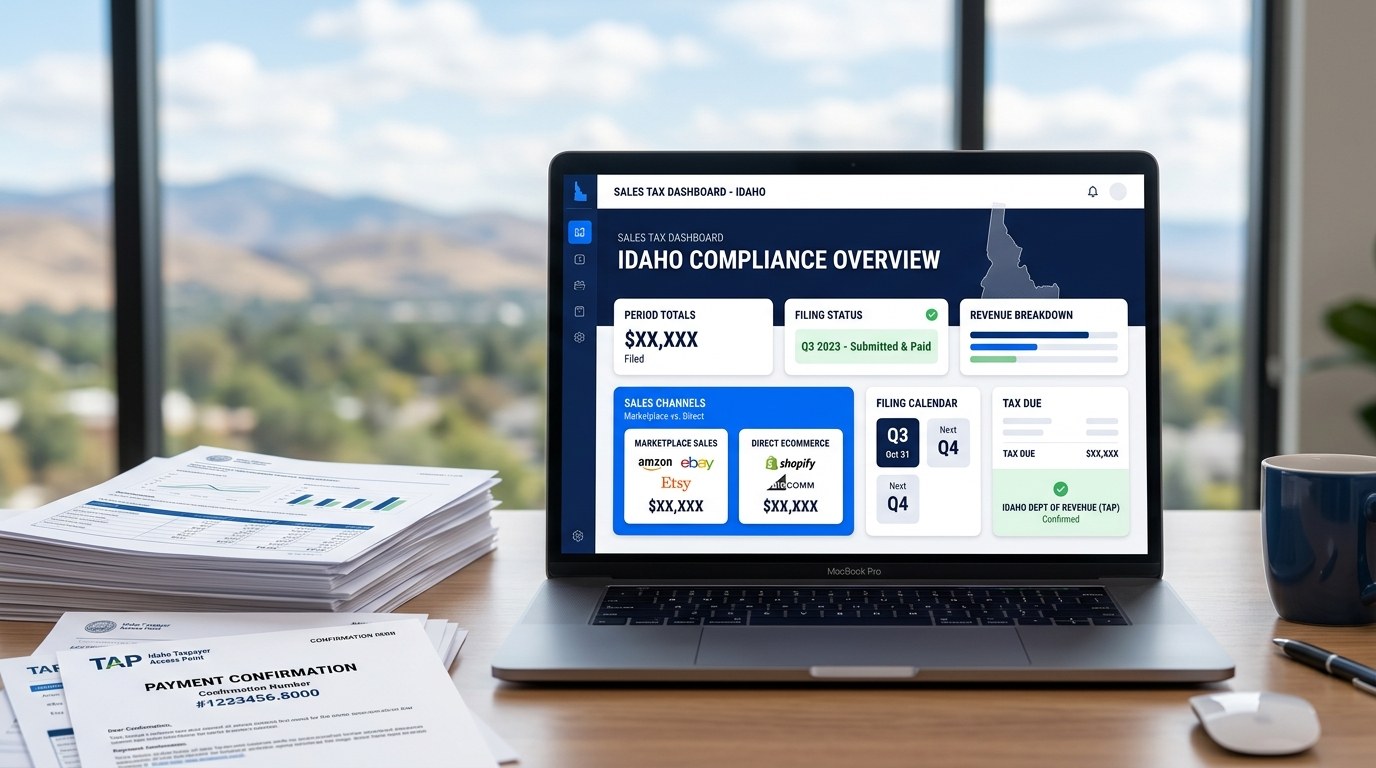
For ecommerce teams, the filing work is about traceability: separating direct and marketplace orders, identifying exempt or resale sales, reconciling tax collected, filing through TAP, and saving the confirmation with the exact reports used to prepare the return.
What creates Idaho sales tax nexus?
Idaho nexus can come from in-state business activity or remote seller volume. Physical presence may include inventory, employees, contractors, offices, warehouses, or representatives in Idaho. Economic nexus can apply even when the seller is located outside Idaho.
- Physical presence: inventory, employees, property, affiliate activity, or regular business operations in Idaho can create obligations.
- Economic nexus: monitor Idaho sales against the $100,000 threshold for remote sellers.
- Marketplace activity: marketplace facilitator sales should be excluded or treated separately when the registered marketplace already reports those sales to Idaho.
- Product taxability: tangible personal property is often taxable, while exemptions and special rules can apply to resale, certain groceries, prescription drugs, medical items, agricultural production, and other categories.
A practical nexus review should use the same order exports the finance team uses for filing: direct ecommerce sales, marketplace sales, refunds, exemptions, delivery locations, taxable sales, and tax collected.
How the Idaho seller's permit fits into the workflow.
Idaho businesses generally register for seller's permits through the Idaho State Tax Commission. Before registering, prepare the legal entity name, EIN, owner or officer details, business address, sales start date, product categories, channel list, payment owner, and the person responsible for filing.
After the account is open, store the permit details, filing frequency, TAP login owner, payment method, return schedule, and internal review process in the compliance workspace. That lets a merchant keep filings moving even when the person who registered the account is not the person preparing returns later.
Collection, local taxes, and marketplace sales.
Idaho's general state sales tax rate is 6%. Some local taxes, auditorium district taxes, travel and convention taxes, or other special taxes may apply depending on the transaction type and location. For online sellers shipping tangible products, destination details and product taxability still matter even in a state with a clear statewide base rate.
- Direct ecommerce sales: orders where the merchant is seller of record and may need to collect Idaho tax.
- Marketplace sales: sales through registered marketplace facilitators should be separated before preparing the return.
- Exempt and resale sales: retain Idaho Form ST-101 or other support when a sale is treated as exempt.
- Refunds and adjustments: keep refunds, discounts, credits, and tax adjustments tied to the exact filing period.
How to prepare an Idaho sales tax filing packet.
Idaho says regular seller's permit holders file returns online through TAP. A return is required even if the seller has no sales for the period. Idaho also notes that marketplace-facilitated sales already reported by registered marketplace facilitators should not be reported again by the seller.
- Export exact-period reports: pull order, refund, tax, exemption, marketplace, and payment reports for the filing period.
- Separate marketplace activity: isolate marketplace-facilitated sales before preparing Idaho totals.
- Map return categories: document gross sales, taxable sales, exempt sales, deductions, use tax, and tax collected.
- Reconcile to accounting: compare platform tax totals, payment processor exports, payouts, and bookkeeping records.
- Prepare reviewer notes: show period, source files, assumptions, exceptions, preparer, reviewer, and approval timestamp.
- Save proof: keep the TAP confirmation, payment receipt, source exports, and final workpaper packet together.
Idaho filing frequency can be monthly, quarterly, semiannual, or annual. Monthly returns are generally due by the 20th day of the following month, quarterly returns are due within 20 days after the quarter ends, semiannual filings are due July 20 and January 20, and annual filings are due January 20.
What happens if Idaho filings are late or unsupported?
Late filing, late payment, missing zero returns, unsupported exemptions, duplicated marketplace reporting, and weak source records can create penalties, interest, amended returns, notices, or audit exposure. Idaho's filing guidance also warns that a seller's permit can be cancelled after repeated zero-sales filings, so active accounts should be reviewed instead of ignored.
Before filing, review this checklist:
- Does the filing period match every export?
- Are marketplace-facilitated sales removed or separately documented?
- Are exemption certificates and resale records saved?
- Do refunds and credits reconcile to the platform reports?
- Does tax collected tie to accounting and payment data?
- Was the TAP confirmation and payment receipt saved?
Idaho sales tax FAQ.
What is Idaho economic nexus?
Idaho remote sellers generally monitor whether sales to Idaho customers exceed $100,000 in the current or previous calendar year.
What is the Idaho sales tax rate?
Idaho's general state sales tax rate is 6%. Additional local or special taxes can apply depending on the jurisdiction and transaction type.
Where do Idaho sellers file?
Idaho sellers with a regular seller's permit generally file and pay online through TAP, Idaho's Taxpayer Access Point.
Do Idaho sellers file zero returns?
Yes. Idaho says sellers with a permit must file a return even when they make no sales during the period.
Can AtomicTax help file Idaho returns?
Yes. AtomicTax helps ecommerce merchants prepare filing-ready packets and complete standard sales tax filings for $45 per filing.
Official Idaho resources to check.
Need help making Idaho filings repeatable?
AtomicTax prepares sales tax filing packets from ecommerce reports, separates marketplace and direct-channel activity, and helps merchants keep every filing period reviewable.